


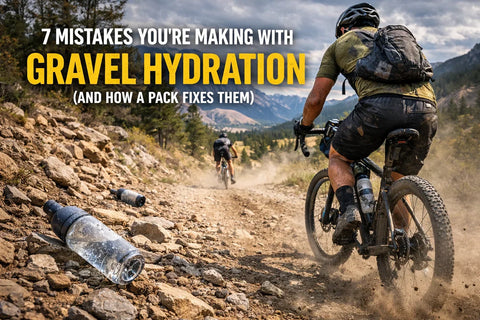
If you’ve spent any time grinding out miles on chunky gravel, you know the drill. The sun is beating down, the "road" looks more like a dried-up creek bed, and your hands are glued to the hoods because the second you let go, a rogue rock threatens to send you sideways. You’re thirsty, but that water bottle sitting three feet below your chin might as well be on the moon.
I’m Josh Sprague, CMO at Orange Mud, and I’ve spent more hours than I can count testing gear on the dirt. I’ve seen riders: from podium finishers to weekend warriors: make the same hydration mistakes over and over. We’ve been conditioned to think that "real" cyclists only use bottles, but the reality of gravel is a different beast entirely.
If you want to ride faster, safer, and further, it’s time to rethink your setup. Here is why a gravel bike hydration pack will change the way you ride, and the seven common mistakes it solves.
1. You’re Prioritizing Energy Over Hydration
We’ve all been there: focusing intensely on how many grams of carbs we’re shoving into our faces every hour while completely forgetting to sip. Here’s the catch: if you’re dehydrated, your gut basically stops working.
When you get dehydrated and your core temperature rises, blood flow is diverted away from your digestive system to your skin to try and cool you down. This slows down gut motility. Suddenly, that expensive gel you just ate is sitting in your stomach like a lead weight because there isn’t enough fluid to help transport those nutrients to your muscles.
How a pack fixes it: A hydration pack makes sipping habitual. Instead of waiting for a "safe" flat section to reach for a bottle, the bite valve is right there. By drinking 500-1,000ml of fluid per hour consistently, you keep the engine primed and the digestive tract moving.
2. Leaving Your Bottles in the "Graveyard"
Gravel racing has a dark side: the bottle graveyard. Every major gravel event, from Unbound to your local grassroots race, is littered with dropped bottles. Those carbon cages might look sleek, but they often lack the grip needed for high-frequency vibrations. Even the best steel cages can get bent out of shape.
Losing a bottle at mile 10 of a 100-mile race isn't just a bummer; it’s a potential DNF (Did Not Finish). If you lose half your hydration capacity early on, you’re in for a world of hurt.
How a pack fixes it: It’s literally strapped to your body. Short of a catastrophic crash, your water isn’t going anywhere. You gain the peace of mind knowing that if you hit a massive pothole at 25mph, your hydration stays with you.
3. Ignoring the "Slow Speed" Heat Trap
Road cycling is fast. You’ve usually got a 20+ mph breeze helping to evaporate sweat and cool you down. Gravel is different. Between the rolling resistance of wider tires and the steep, technical climbs, your average speed is often much lower.
Lower speed means less airflow. Less airflow means you get hotter, faster.
How a pack fixes it: When thermoregulation becomes a challenge, you need volume. Most gravel frames can only hold two bottles: maybe three if you have mounts under the down tube (where they get covered in cow manure, by the way). A pack allows you to carry 2+ liters of cold fluid. Not only does this give you more to drink, but having a cold reservoir against your back can actually help keep your core temperature down during those grueling, low-speed climbs.

4. The "Plain Water" Electrolyte Gap
I see a lot of riders carrying two bottles of plain water and hoping for the best. On a two-hour road ride, you might get away with it. On a six-hour gravel epic in July? No chance. You’re losing massive amounts of sodium through sweat, and if you only replace it with plain water, you’re courting hyponatremia: or at the very least, some nasty leg cramps and a massive power drop.
How a pack fixes it: It’s much easier to manage your electrolyte ratios in a large reservoir. You can mix your specific concentration once and know you’re getting a consistent hit of sodium and minerals with every sip. Plus, our packs are designed to be easy to clean, so you don’t have to worry about "science experiments" growing in your bladder after the race.
5. Playing "Catch-Up" with Your Stomach
Once you feel thirsty, you’re already behind. Once you feel nauseous or bloated, you’re in a "hydration hole" that is incredibly hard to climb out of mid-race. Dehydration-related stomach issues are the leading cause of mid-race blowouts in endurance sports.
Reactive hydration (drinking a whole bottle at once because you finally found a smooth road) usually leads to "sloshy belly." Your stomach can only process so much fluid at a time.
How a pack fixes it: The "little and often" approach. Because the straw is inches from your mouth, you tend to take small sips every few minutes. This micro-dosing of fluids is much easier for your stomach to handle and keeps your hydration levels stable rather than a series of peaks and valleys.

6. Taking Your Hands Off the Bars at the Wrong Time
The first hour of a gravel race is pure chaos. You’re in a pack, the dust is flying, and everyone is fighting for the best line to avoid a puncture. This is exactly when you should be drinking to stay ahead of the curve, but it’s also the most dangerous time to reach down for a bottle.
One hand on the bars over chunky gravel is a recipe for a front-wheel washout.
How a pack fixes it: Safety. You can keep both hands firmly on the bars: or even stay in the drops for better control: while you hydrate. Whether you’re navigating a technical descent or holding a wheel in a fast paceline, you don't have to choose between safety and thirst.
7. Over-Reliance on Feed Zones
Gravel racing is about self-sufficiency. Unlike a supported Gran Fondo, gravel aid stations can be 40 or 50 miles apart. If it’s hotter than expected, or if you miss a turn and add five miles to your route, those two bottles aren't going to cut it. I’ve seen pro riders like Ian Boswell and Alexey Vermeulen rock hydration packs not because they can't handle a bottle, but because it’s a safety buffer.
How a pack fixes it: It gives you independence. You can skip a crowded aid station if you’re feeling good, or you can take your time and know you have enough "fuel" to get to the next remote checkpoint. It turns a stressful "Will I make it?" situation into a "I've got this" situation.
Why an Orange Mud Pack is Different
Now, I know what some of you are thinking. "I don't want a hot, sweaty backpack bouncing around while I'm trying to ride."
That’s exactly why we designed our packs the way we did. Most hydration packs were built for hiking or mountain biking, sitting low on the back and trapping heat. Orange Mud packs, like our Vantage series, sit high on the shoulders.
This does three things for a gravel rider:
- Access to Jersey Pockets: You can still reach your snacks and tools in your jersey pockets because the pack sits above them.
- No Bounce: By securing the load high on the stable part of your back (the thoracic spine), the pack doesn't "wag the dog" when you're out of the saddle climbing.
- Breathability: Less surface area contact means your back can actually breathe.
Final Thoughts: Change the Way You Ride
Gravel riding is about the freedom to explore where the pavement ends. It shouldn't be a constant battle against thirst and equipment failure. By moving your primary hydration to your back, you simplify your ride. You protect your gut, you keep your hands on the bars, and you stop leaving your expensive bottles in the middle of a dirt road in Kansas.
Next time you head out for a long day on the gravel, swap the bottles for a pack. I promise you’ll find yourself riding stronger in the final third of the day than you ever have before.
See you out on the dirt!
: Josh
Looking to upgrade your gravel setup? Check out our full range of high-performance hydration packs and accessories designed for the toughest terrain.